Handwriting practice for today will be using pangrams. Do you know what those are? Before you read on and watch the video, leave me a comment on what your think a pangram is.
I know the audio is a little not there. I am new at this. So the video is of me writing out the pangram sentences:
The quick brown fox, jumped over the lazy dog.
A wizard's job is to vex chumps quickly in fog.
A pangram sentence is a sentence that uses all the letters of the alphabet. It also follows the rules of regular sentences, with a subject, verb, and noun. But its also playing with words. A excellent pangram sentence using the fewest letter repeats.
The assignment is to follow along and write the pangram sentences like I have in the video, as well as to make up your own pangram. Write these in cursive and turn into me at the next class meeting,
Saturday, March 28, 2020

The Bugliest Bug by Carol Diggory Shelids

Today we are listening to me read the The Buggliest Bug, It is one of my favorite stories about a little bug who encounters a problem, and with the help of her friends they solve the problem.
Sunday, March 22, 2020
Esperanza Rising by Pam Munoz Ryan
We are about to start a new novel in class, "Esperanza Rising" This is a story about a girl about your age. She was born into a wealthy family in Mexico and had lived a privilege life. But all that changes, as life does. This book is about what happens to her, and she grows and changes because of that.

In order to get ready for reading this novel in class, I want you to familiarize yourselves with some words we will find in the text. Your assignment for tonight is to first read the word on the first slide. Then on a sheet of paper I want you to write down what you think that word means. NO PEEKING!!! The next slide will give you the definition of the word. If you are right, give your self a star. If you tried, and were off a little bit write down the correct definition next to what you thought it was.
Turn in your sheet of definitions tomorrow at the start of class.
Sunday, March 8, 2020
Current Events
In class today we talked about media, and how it relates to our lives. Studying current events helps us understand the importance of people, events, and issued in the news. This encourages students to explore and learn more about the news and and see what is happening in the world
This is a daily news cast put out by CNN, that is focused on students and current events that are happening around them.
After watching this video, leave a comment below telling me one new interesting thing you learned.
Sunday, March 1, 2020
STEM PROJECT: CATAPULTS
Learning Expectations:
(3-5-ETS1) Define a simple design problem that can be solved through development of an object, tool, process, or system and includes several criteria for success and constraints on material, time, and cost.
(3-5-ETS1-2) Generate and compare multiple solutions to a problem based on how well they meet the criteria and constraints of the design problem. Use evidence (observations, measurements, patterns) to construct an explanation.
(3-5-ETS1-3) Plans and conduct an investigation collaboratively to produce data to serve as the basis for evidence, using fair tests in which variables are controlled and the number of trials are considered.
 You are an engineer who specializes in designing cool toys and machines for games.
You were recently contacted by the Ancient Toy Company to help design a machine called a
catapult for a game that will launch Ping-Pong balls at a series of targets. To ensure that children
and adults alike will love the game, you need to make sure the catapult is both accurate and precise. You will be expected to follow the direction on the handouts given out in class, as have prototype drawings to show on launch day.
You are an engineer who specializes in designing cool toys and machines for games.
You were recently contacted by the Ancient Toy Company to help design a machine called a
catapult for a game that will launch Ping-Pong balls at a series of targets. To ensure that children
and adults alike will love the game, you need to make sure the catapult is both accurate and precise. You will be expected to follow the direction on the handouts given out in class, as have prototype drawings to show on launch day.
(3-5-ETS1) Define a simple design problem that can be solved through development of an object, tool, process, or system and includes several criteria for success and constraints on material, time, and cost.
(3-5-ETS1-2) Generate and compare multiple solutions to a problem based on how well they meet the criteria and constraints of the design problem. Use evidence (observations, measurements, patterns) to construct an explanation.
(3-5-ETS1-3) Plans and conduct an investigation collaboratively to produce data to serve as the basis for evidence, using fair tests in which variables are controlled and the number of trials are considered.
STEM @ Home
Today in class we started talking about catapults and some of the math and science behind them. So what do you know about catapults?
To learn more about catapults use this link.Catapults have many uses, and your probably thinking about them as a weapon of ancient warfare. But catapults are used today in many different ways, from toys to launching air planes on limited runway space.
Lets say we want our catapults to launch Ping-Pong balls on a target. Think about what are some science concepts that will be used?
Force, is one concept that will be in use. Force is strength or energy as an attribute of movement. The stronger the force, the faster and farther it moves. So the more force applied to the catapult, the more force is applied to the object being launched. Think of a plastic spoon, the more force applied by pulling the top back, the faster and farther the object being thrown goes. A sling shot is another good example. The farther you pull back the bang, the farther and faster the projectile goes.
The challenge for this lesson is to design and build a catapult that will launch a ping-pong ball onto a target set up a few feet away.
You will need to brainstorm with your adults and come up with a sketch of your design, and then build a prototype that you will text at home. And then bring to school in 2 weeks time, for launch day. On this day you will be observing your fellow students catapults, presenting your catapult to the class, as well as making predictions to who's will have the highest, and farthest launches. In the video link below there are some examples for you to review with your adults.
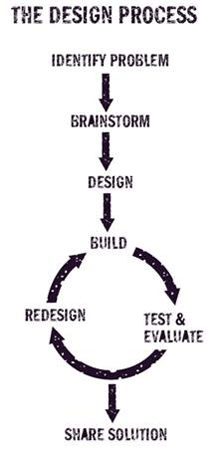
Introduction to the DESIGN PROCESS
The engineering design process emphasizes open-ended problem solving and encourages students to learn from failure. This process nurtured students' abilities to create innovative solutions to challenges in any subject.
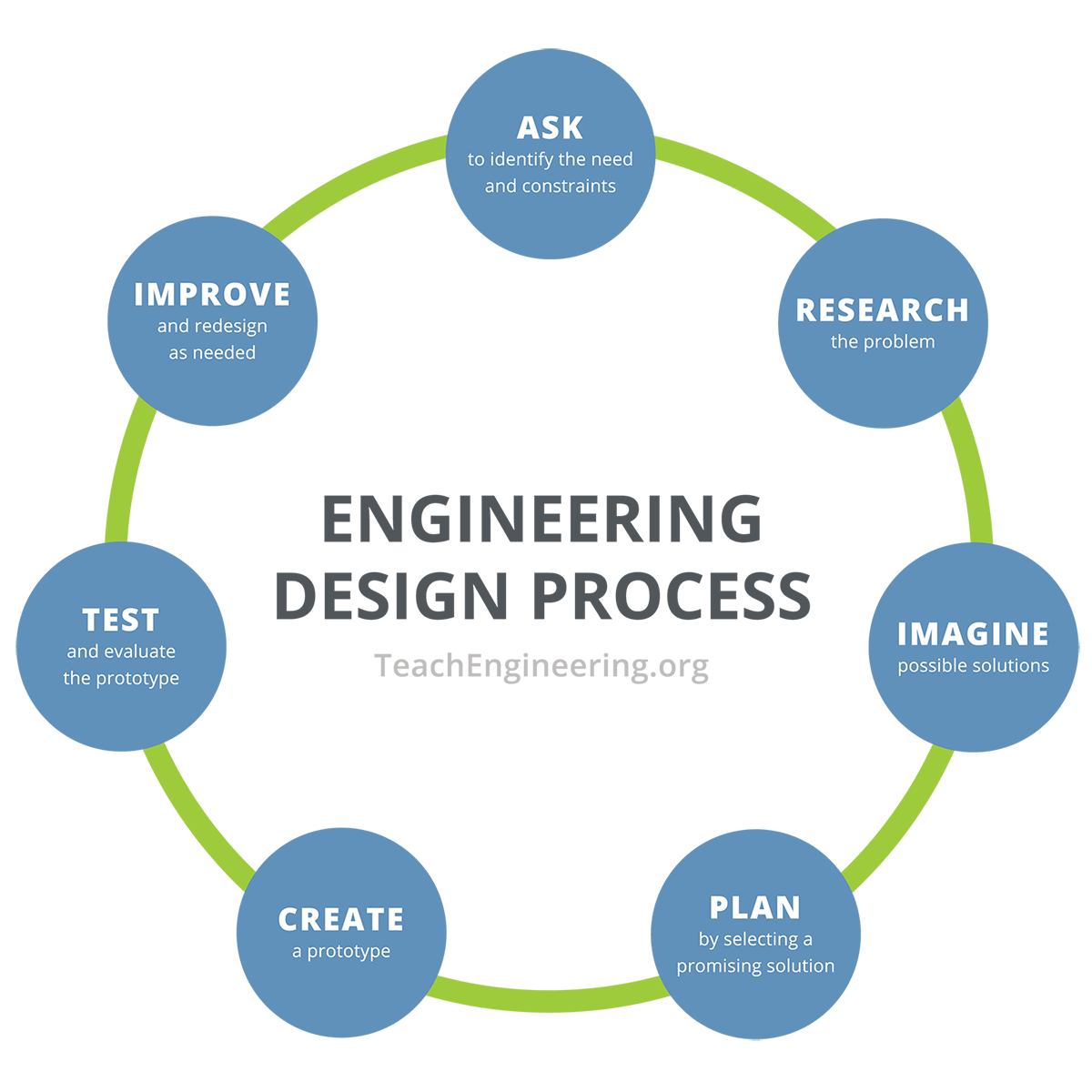
Engineers ask important questions about what they want to create, whether is is a skyscraper, smartphone, or blender. Some of these questions might be: What is the problem to solve? What do we want to design? Who is it for? What are the limitations? How can I make something better?
This includes talking to many different people with different backgrounds and specialties. And researching what products or solutions already exist, or what technologies might be adaptable to your needs.
Working as a team to brainstorm ideals and develop many possible solutions. Encourage wild ideas and build on others ideals. Stay focused on the topic, good design is all about teamwork.
This might be the hardest step. Revisit all those solutions you've come up with, compare all your best ideas. Select one solution and make a plan to move forward with it.
Building a prototype makes your ideas real! These early versions of your designs help verify if your design meets the original challenge objectives. Push yourself for creativity, imagination, and excellence.
Did it work? Does it solve the problem? Communicate the results and get feedback. Analyze and talk about what works and what could be better.
Talk about how you could make improvements. Make those improvements. Draw new designs, make your product the best it can be. And REPEAT!
This includes talking to many different people with different backgrounds and specialties. And researching what products or solutions already exist, or what technologies might be adaptable to your needs.
Working as a team to brainstorm ideals and develop many possible solutions. Encourage wild ideas and build on others ideals. Stay focused on the topic, good design is all about teamwork.
This might be the hardest step. Revisit all those solutions you've come up with, compare all your best ideas. Select one solution and make a plan to move forward with it.
Building a prototype makes your ideas real! These early versions of your designs help verify if your design meets the original challenge objectives. Push yourself for creativity, imagination, and excellence.
Did it work? Does it solve the problem? Communicate the results and get feedback. Analyze and talk about what works and what could be better.
Talk about how you could make improvements. Make those improvements. Draw new designs, make your product the best it can be. And REPEAT!
2020 Syllabus
Welcome/Introduction:
We would like to take this opportunity to welcome you and your child to fourth
grade. We are looking forward to a terrific year. If you have any questions or
concerns as the year progresses, please contact us by phone, email or through
notes in the Student Agenda.
You are an integral part
of your child’s success. Together, we can make this year a wonderful experience
for your child.
Academic Goals for the
Year:
In reading this year our focus will be on nurturing the love of reading while developing foundation skills for reading and comprehending more complex text.
Students will be engaged
in daily writing to develop the skills required to communicate clearly
and effectively.
During math this
year, we will provide students with a balanced mathematics curriculum that is
rich in real-world problem-solving opportunities.
Through science
instruction students will be engaged in activities to build a strong science
foundation and help develop a full understanding of the inquiry process.
Social studies
will focus on the history and culture of Kentucky, past and present.
Your child will be given a
variety of opportunities to demonstrate learning through writing in all subject
areas.
Daily Schedule:
8:00-8:30 Morning Procedures
8:30-9:15 Writing
9:15-10:00 Whole Group Reading
10:00–10:10 Restroom Break/Take Ten
10:10-10:55 Specials
10:55 – 11:35 Small Group Reading
11:35-12:15 Science/Social Studies
12:15-12:55 Lunch/Recess
12:55-1:50 Whole Group Math
1:50-2:00 Restroom Break/Take Ten
2:00-2:50 Small Group Math
2:50-3:15 Technology
3:15-3:25 End of Day Procedures
8:00-8:30 Morning Procedures
8:30-9:15 Writing
9:15-10:00 Whole Group Reading
10:00–10:10 Restroom Break/Take Ten
10:10-10:55 Specials
10:55 – 11:35 Small Group Reading
11:35-12:15 Science/Social Studies
12:15-12:55 Lunch/Recess
12:55-1:50 Whole Group Math
1:50-2:00 Restroom Break/Take Ten
2:00-2:50 Small Group Math
2:50-3:15 Technology
3:15-3:25 End of Day Procedures
Assessments/Grades/Scale:
100-point scale (4-point scale) (2-point scale)
A- 93-100 (4) (2)
B- 85-92 (3)
C- 73-84 (2) (1)
D- 65-72 (1)
F- 0-64 (0) (0)
100-point scale (4-point scale) (2-point scale)
A- 93-100 (4) (2)
B- 85-92 (3)
C- 73-84 (2) (1)
D- 65-72 (1)
F- 0-64 (0) (0)
GRADING
· Listed above is the grading scale that will be used to score your child’s assignments in order to communicate your child’s level of mastery of content.
· Before sending graded assessments home, students will complete Wrong Answer Analysis. This is a process where students analyze their responses and use their resources to correct any misconceptions. Questions are reviewed and discussed in class prior to making corrections independently. This practice allows students an opportunity to reach mastery of the skills or concepts taught while improving overall grades.
· Our goal is to help students learn at high levels. We will do everything we can to help your child be successful and achieve at high levels
· Listed above is the grading scale that will be used to score your child’s assignments in order to communicate your child’s level of mastery of content.
· Before sending graded assessments home, students will complete Wrong Answer Analysis. This is a process where students analyze their responses and use their resources to correct any misconceptions. Questions are reviewed and discussed in class prior to making corrections independently. This practice allows students an opportunity to reach mastery of the skills or concepts taught while improving overall grades.
· Our goal is to help students learn at high levels. We will do everything we can to help your child be successful and achieve at high levels
Homework will often be checked in class and be used as a teaching tool.
· On Friday, any missing assignments will be sent home to be completed and turned in on Monday. Failure to do so will result in recess make-ups on Tuesday.
Students are responsible
for completing assignments that are missed when they are absent. For planned
absences parents should contact their child’s teacher to arrange for the
assignments prior to the absence. Students have the same number of days they
were absent to complete make-up assignments. For example, if a child is absent
for one day, the make-up assignments are due the day after they return to
school. If a student is absent for 3 days, make-up assignments are due on the
3rd day after the day they return.
Communication:
We will be communicating regularly through student agendas and emails. Please feel free to contact your child’s teacher whenever you have a concern. You may call and leave a voicemail during the day; however, email is most efficient as we check it at least once a day. There are days that we do not get to check email until after dismissal, so urgent messages should be sent in with your child or call the office.
We will be communicating regularly through student agendas and emails. Please feel free to contact your child’s teacher whenever you have a concern. You may call and leave a voicemail during the day; however, email is most efficient as we check it at least once a day. There are days that we do not get to check email until after dismissal, so urgent messages should be sent in with your child or call the office.
Teacher emails may be
accessed through the Schools Web Page.
Expectations for Student
Behavior: Check your child’s agenda daily for any notes on behavior. If there
are no comments written or notes attached, then your child has turned in all
work and demonstrated appropriate behavior for the day.
Notes will also be written
about positive behaviors deserving of extra praise.
Subscribe to:
Comments (Atom)